
Key Takeaways
- A breast cancer clinical trial is a structured research study that explores better ways to prevent, detect, or treat breast cancer.
- Trials are carefully regulated and move through phases (I–IV) to evaluate safety, effectiveness, and long-term outcomes before becoming standard care.
- Eligibility is based on medical factors like cancer stage, subtype, biomarkers, and treatment history—not how advanced or severe your condition feels.
- Multiple types of trials exist today, including HER2-targeted therapy trials, hormone receptor-positive studies, triple-negative breast cancer research, and metastatic breast cancer management trials.
- Most patients do not receive placebos alone; if used, placebos are typically combined with standard treatment to ensure no one is left without care.
- Clinical trials may provide access to investigational therapies and involve close medical monitoring, but they also carry risks such as unknown side effects or uncertain effectiveness.
- Support is available through organizations like NHO Revive, which conducts cancer clinical trials and helps patients find suitable studies and guides them through the process.
The moment the doctor leaves the room after delivering a breast cancer diagnosis, the world changes. Suddenly, you are flooded with a sea of complex terms, staging numbers, and treatment schedules. It feels overwhelming, and the pressure to make the “right” choice can be heavy. During one of these appointments, your oncologist may have briefly mentioned a clinical trial as an option. But between the stress and the jargon, it’s completely normal if that suggestion flew right over your head or sounded intimidating.
You might be wondering if a trial is a last resort, if it’s safe, or how it even works. This blog is written to clear away the confusion. We will answer exactly what a breast cancer clinical trial involves, who can join, what types of treatments are being studied, and how you can take control of your care. You deserve clear, straightforward answers so you can make the best choice for your health.
What Is a Breast Cancer Clinical Trial?
A breast cancer clinical trial is a highly organized research study designed to find better ways to prevent, detect, or treat the disease. It is simply the way doctors and patients work together to find better options for everyone.
It helps to understand that there are two main types of studies: treatment trials, which test potential new drugs, combinations of therapies, or surgical techniques; and observational studies, which don’t change your medical care but monitor health outcomes over time to better understand the disease.
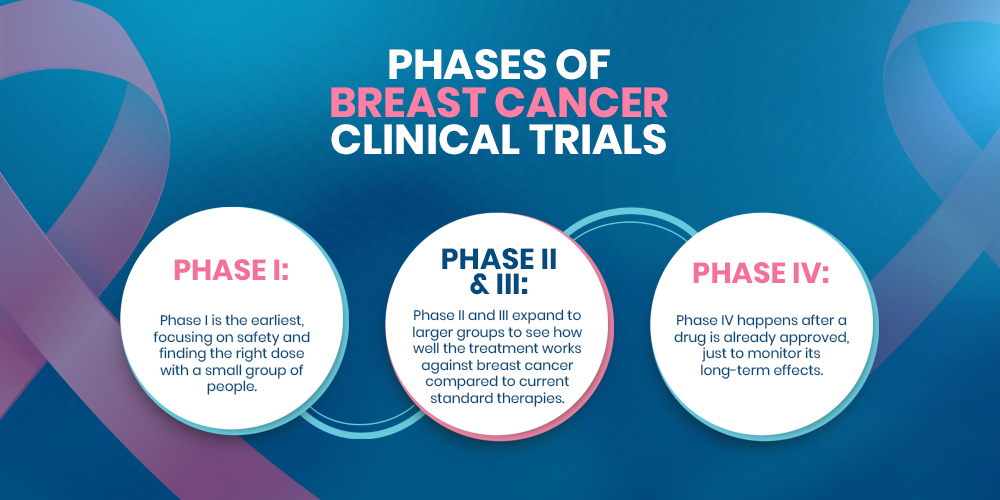
When people hear about clinical trials, they often worry about the “phases” they hear doctors talk about. To keep it simple, trials move through phases (I through IV) to carefully evaluate a treatment.
- Phase I is the earliest, focusing on safety and finding the right dose with a small group of people.
- Phase II and III expand to larger groups to see how well the treatment works against breast cancer compared to current standard therapies.
- Phase IV happens after a drug is already approved, just to monitor its long-term effects.
The most important thing to know is that a clinical trial is not an experimental free-for-all; it is a deeply regulated, carefully monitored path to test potential new treatment options.
Who Can Join a Breast Cancer Clinical Trial?
There is a common misconception that clinical trials are only for people who have exhausted every other medical option or are incredibly sick. That simply isn’t true. Eligibility for a study is based on very specific medical criteria—such as your exact breast cancer stage (Stage 0 to Stage IV), cancer type, genetic markers, and treatment history—not on how advanced your illness feels.
Because of this, trials are available for people at many different points in their cancer journey:
Newly Diagnosed Patients:
You might qualify for what doctors call “first-line” trials. These are studies for people who have just been diagnosed and haven’t started any treatment yet. Typically, these trials combine the standard care you would normally get with a new investigational treatment to see if the combination works better than the standard therapy alone.
Patients Already in Treatment:
If you are currently undergoing therapy and finding that the side effects are too harsh, or if your latest scan shows that the current treatment isn’t working as well as your doctors hoped, a clinical trial may open up a completely new avenue of potential treatment options.
Caregivers Looking Out for Loved Ones:
If you are reading this on behalf of a family member or friend, please know that you don’t have to wait for a doctor to bring this up. Caregivers can actively inquire about open trials, gather information, and advocate for their loved ones to see if a study might be a good fit.
What Types of Breast Cancer Trials Are Currently Available?
Breast cancer is not just one disease; it is many different diseases defined by their cellular makeup. Because of this, modern research has shifted away from a one-size-fits-all approach and moved toward highly targeted therapies.
Medical research is currently exploring several key areas to fight breast cancer more effectively:
HER2-Targeted Therapies:
For HER2-positive breast cancer, where cancer cells overexpress the HER2 protein, researchers are investigating new generations of smart drugs, such as antibody-drug conjugates. They act like guided delivery systems, delivering powerful therapy directly to the cancer cells while sparing healthy tissue.
Hormone Receptor-Positive Treatments:
For estrogen or progesterone-positive cancers, studies are currently exploring potential new ways to overcome hormone resistance, ensuring that therapies designed to block these hormones keep working effectively for much longer.
Triple-Negative Breast Cancer (TNBC) Therapies:
Because triple-negative breast cancer lacks the three most common receptors, traditional hormone therapies don’t work. Current research is heavily focused on combining innovative immunotherapies—which train your own immune system to recognize and attack the cancer—with specific targeted therapies to break through the defenses of this aggressive subtype.
Metastatic Breast Cancer Management:
When breast cancer spreads to other parts of the body, it is called metastatic breast cancer. At this stage, the goal shifts to prolong survival and maintain a good quality of life. Current trials are examining novel maintenance therapies and combinations designed to keep the cancer at bay even when older treatments have stopped working.
NHO Revive is currently enrolling patients for breast cancer clinical trials in Lincoln, Nebraska. A coordinator can walk you through eligibility in a single call — no referral needed. See if you qualify
How Do You Find the Right Breast Cancer Trial?
Finding the right breast cancer clinical trial can feel like looking for a needle in a haystack if you try to do it alone online. The very best place to start is with a conversation.
Bring the topic up with your oncologist. You don’t need to be an expert to ask about it. You can start with simple, direct questions like:
- Are there any clinical trials that fit my specific type of breast cancer?
- What is this specific trial testing, and how does it differ from standard treatment?
- What will the clinic visits look like, and how often will I need to travel?
- What happens if I decide I want to stop the trial later?
This is also where the team at NHO Revive comes in. Our clinical trial coordinators act as your personal guides. Instead of forcing you to navigate massive medical databases, our coordinators review your specific medical history, look at our currently open studies, and find the exact match for your situation. It turns what could be a cold, overwhelming search into a warm, supportive conversation.
What Are the Benefits and Risks?
Choosing to enter a clinical trial is a deeply personal decision, and it requires weighing both sides honestly.
The Potential Benefits
- First and foremost, a trial gives you access to groundbreaking treatments that are not yet widely available to the public.
- If an investigational therapy proves to be highly effective, trial participants are the very first people in the world to benefit from it.
- Additionally, trial participants receive an extraordinary level of care.
- You are monitored closely by a dedicated research team of doctors and nurses, meaning you often get more check-ins, scans, and personalized attention than you would on standard care alone.
The Risks and Reality
- There are, of course, risks. The new treatment may cause side effects that doctors cannot fully predict, or it may simply not work as well as hoped for your specific cancer.
- Many patients also express deep anxiety about placebos, worrying they will receive a “sugar pill” instead of real medicine.
- Let us be completely honest: in cancer trials, you are almost never given a placebo alone if an effective standard treatment exists.
- Placebos are usually given with standard treatment to see if a new study drug added to normal care works better than standard treatment alone. A clinical trial may be structured as follows:
- Group A: Placebo + standard care
- Group B: Investigational drug + standard care
- Lastly, remember your rights: you are a volunteer. You retain the absolute right to withdraw from a clinical trial at any time, for any reason, without it affecting your relationship with your doctors or your future care.
Taking the Next Step
By now, you know that clinical trials are not an act of desperation, but a highly controlled, proactive choice to access potential new treatment options. You know that eligibility depends on your specific type of cancer rather than how sick you are, and that you will always be treated with the highest standards of safety and care.
Facing a breast cancer diagnosis requires immense courage, but you do not have to figure out the medical landscape by yourself. You don’t have to have all the answers or understand every medical acronym before reaching out to us. The NHO Revive team’s job is to answer your questions, not the other way around. We are here to listen, understand your situation, and help you discover if a trial is the empowering next step you’ve been looking for.
Ready to learn if a breast cancer trial is right for you? NHO Revive is enrolling breast cancer clinical trials in Lincoln, Nebraska.
Frequently Asked Questions
What is the difference between a clinical trial and standard treatment?
Standard treatment consists of therapies that are already approved by federal regulators and are widely accepted as the current baseline care for breast cancer. A clinical trial tests potential new therapies or unique combinations that are not yet widely available, aiming to find an approach that works better or has fewer side effects than the current standard.
Can I join a breast cancer trial if I'm already receiving chemotherapy?
Yes, depending on the specific trial’s rules. While some trials require you to have had no prior treatment, many others are specifically designed for patients who are currently undergoing chemotherapy or whose cancer has shown resistance to their current regimen.
Are breast cancer clinical trials safe?
Patient safety is the absolute highest priority in any clinical trial. Every study must be reviewed and approved by an independent ethics board before it begins, and participants are monitored much more frequently and rigorously by a specialized medical team than they would be during standard treatment.
Will I receive a placebo in a breast cancer trial?
It is incredibly rare to receive only a placebo in a breast cancer trial. If a placebo is used, it is almost always given in combination with the standard, proven treatment you would normally receive, ensuring you are never left unprotected or untreated.
How do I know if I qualify for a breast cancer clinical trial?
Qualification is determined by an evaluation of your specific breast cancer stage, tumor biomarkers, genetic profile, and treatment history. The easiest way to find out is to speak with a clinical research coordinator, who can review your records and help determine your eligibility.