
Quick Answer
Lung Metastasis occurs when cancer spreads from its original location to the lungs. Cancer cells can travel through the bloodstream or lymphatic system and form new tumors in lung tissue. Symptoms may include persistent coughing, shortness of breath, chest discomfort, coughing up blood, or no noticeable symptoms at all. Diagnosis typically involves imaging and, when needed, a biopsy or other tests to identify the cancer’s origin. Although metastatic cancer is often challenging to cure, treatments may help control its growth, relieve symptoms, and support quality of life.
Key Takeaways
- Cancer that reaches the lungs can come from the lungs themselves or from another organ, and the origin guides treatment.
- Early signs such as a lingering cough or shortness of breath are easy to overlook, and some people have no symptoms.
- Diagnosis relies on imaging, biopsy and biomarker testing.
- Treatment may include targeted therapy, immunotherapy, chemotherapy, hormone therapy, radiation, selected surgery and supportive care.
- Survival statistics are group averages and cannot predict an individual’s outcome.
What Is Lung Metastasis?
Lung metastasis refers to cancer that begins elsewhere in the body and subsequently spreads to one or both lungs. The original tumor is called the primary cancer, while a tumor formed after cancer cells spread to the lungs is a secondary tumor or metastatic deposit.
According to the NCI, metastatic cancer retains the identity of its original cancer. This means a breast cancer tumor found in the lungs is still classified as breast cancer, even though it is growing in lung tissue.
The term Metastatic Cancer in lungs describes this situation. It should not automatically be confused with lung cancer that begins with the respiratory system.
For example:
- Breast cancer spreading to the lungs is metastatic breast cancer.
- Colon cancer spreading to the lungs is metastatic colorectal cancer.
- Kidney cancer spreading to the lungs is metastatic kidney cancer.
- Cancer that begins in the lungs and spreads to another organ is metastatic lung cancer.
A Tumor spread to lungs diagnosis can involve a single tumor or multiple nodules. The number, size, and location of these growths can vary considerably. Not every lung nodule is cancerous, so imaging findings need to be interpreted alongside the person’s medical history and any necessary diagnostic tests.
The term Metastatic lung disease is sometimes used when discussing cancer-related spread to the lungs. However, its meaning should be clarified in context because the lungs can also be affected by noncancerous diseases.
How Does Cancer Spread to the Lungs?
Cancer spreads when cells separate from a primary tumor, enter surrounding tissues or circulation, and establish growth in another location. Cancer cells can travel through the bloodstream or lymphatic system before reaching distant organs.
The lungs contain an extensive network of blood vessels, making them a potential destination for cancer cells circulating through the body. However, not every cancer type spreads to the lungs at the same rate or with the same likelihood.
The process generally involves several steps:
- Cancer cells break away from the original tumor.
- Some cells enter nearby tissue, blood vessels, or lymphatic vessels.
- Cells travel through the body and reach distant tissues.
- A small proportion survives and establishes themselves in a new location.
- These cells may grow into metastatic tumors over time.
Which Cancers Commonly Spread to the Lungs?
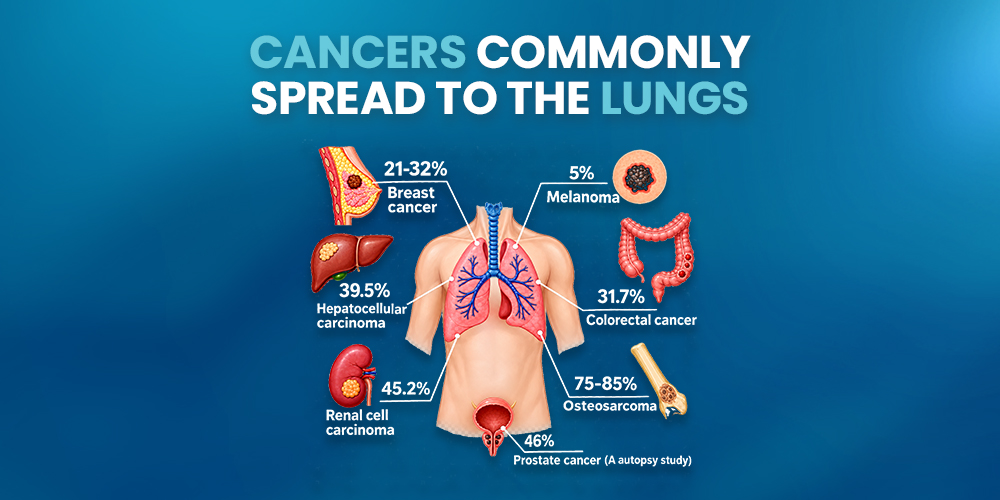
Several cancers may spread to lung tissue. Common examples include:
- Breast cancer metastasis to lung: Breast cancer cells establish secondary tumors in one or both lungs.
- Colon cancer metastasis to lung: Colorectal cancer can spread through the bloodstream, including the lungs.
- Kidney cancer: Kidney tumors can spread to the lungs, bones, liver, or other locations.
- Melanoma: This skin cancer may spread to the lungs, brain, liver, or other organs.
- Sarcomas: Some cancers arising in connective tissues can spread to the lungs.
The location of a secondary tumor does not change the cancer’s original identity. Treatment is generally planned around the primary cancer characteristics, rather than treating the disease as a new lung cancer simply because the lungs are involved.
Lung Metastasis Symptoms: What Should You Look For?
Lung metastasis symptoms vary depending on the number and location of tumors, how quickly they grow, and whether the cancer has affected nearby structures or other organs. Some people experience respiratory symptoms, while others have no obvious signs and discover the metastases during imaging performed for another reason.
Possible symptoms include:
- Persistent cough: A cough that continues or changes over time.
- Shortness of breath: Difficulty breathing during activity or at rest.
- Chest pain or discomfort: Pain that may worsen with deep breathing or coughing.
- Coughing blood: Blood in the sputum, even in small amounts, requires prompt medical assessment.
- Recurrent respiratory infections: Repeated infections may occur in some circumstances.
- Unexplained fatigue or weight loss: These symptoms can accompany cancer but are not specific to lung involvement.
Symptoms may also come from primary cancer, treatment of side effects, infections, or other medical conditions. Their presence alone cannot confirm metastatic disease.
How Is Lung Metastasis Diagnosed?
Diagnosing lung metastases involves determining whether suspicious lung findings represent cancer, identifying the cancer’s origin, and assessing how far the disease has spread. The tests selected depend on the person’s symptoms, medical history, previous test results, and suspected primary cancer.
1. Imaging Tests
Doctors may use one or more imaging procedures to examine the lungs and other areas of the body.
- Chest X-ray: May identify suspicious lung abnormalities, although smaller lesions can be difficult to detect.
- Computed tomography (CT): Provides detailed images of the lungs and can help identify the size, number, and location of nodules.
- Positron emission tomography (PET): May help evaluate areas of abnormal metabolic activity and assess possible spread.
- Magnetic resonance imaging (MRI): May be used to investigate areas, including the brain, when clinically indicated.
Imaging findings can suggest metastasis but do not always establish a definitive diagnosis.
Biopsy and Laboratory Testing
A biopsy involves collecting a tissue sample for examination. Depending on the location of a suspected tumor, doctors may obtain a sample using a needle, bronchoscopy, or another procedure.
Pathologists examine the sample to determine whether cancer is present and may use specialized laboratory tests to help identify its origin. Molecular testing may also identify changes relevant to treatment selection in certain cancers.
Not every patient requires the same tests. The care team determines whether a biopsy or additional testing is appropriate based on the clinical situation.
Staging and Identifying the Primary Cancer
Staging helps establish the extent of the disease. Doctors may review previous pathology reports, conduct additional imaging, and assess other organs to determine whether cancer has spread beyond the lungs.
This process distinguishes metastatic disease from unrelated lung cancer. That distinction is particularly important when evaluating Metastatic lung disease in someone who has previously received treatment for another cancer.
Metastatic Lung Cancer vs Cancer That Spreads to the Lungs
These terms sound similar, but they describe different clinical situations. Metastatic lung cancer generally refers to lung cancer that has spread to distant sites, such as the brain, bones, liver, or other parts of the body. In contrast, cancer that spreads to the lungs originates in another organ.
| Feature | Primary lung cancer with metastasis | Cancer that spreads to the lungs |
|---|---|---|
| Original location | Lung | Another organ, such as the breast or colon |
| Cancer cell identity | Lung cancer cells | Cells from the original cancer |
| Classification | Metastatic lung cancer | Metastatic cancer of the original type |
| Treatment planning | Based on lung cancer type and other factors | Based on the original cancer and its characteristics |
Primary lung cancer is commonly classified into two main groups: small cell lung cancer and non-small cell lung cancer.
- Small Cell Lung Cancer (SCLC) is generally fast-growing and can spread early.
- Non-Small Cell Lung Cancer (NSCLC) includes several types of lung cancer and accounts for the majority of lung cancer cases.
- Small Cell vs Non Small Cell Lung Cancer is an important distinction because these groups differ in their biological characteristics and typical treatment approaches.
- Large Cell Lung Carcinoma (LCLC) is a less common NSCLC subtype characterized by large-appearing cancer cells under a microscope.
- Adenocarcinoma of Lung is a type of NSCLC that commonly develops in cells that produce mucus and other substances.
A Lung Tumor can be benign or malignant, and a malignant tumor may originate in the lung or represent a secondary deposit from another cancer. The term Lung Cancer should therefore be used with an understanding of where the disease began and what diagnostic testing has been established.
These distinctions help doctors select appropriate treatment and determine whether lung cancer-specific clinical trials or trials for another primary cancer may be relevant.
Lung Cancer Metastasis Treatment: What Are the Options?
Lung cancer metastasis treatment depends on the type of cancer, the sites affected, the extent of spread, the person’s overall health, previous therapies, and the goals of care.
When cancer spreads to the lungs from another organ, treatment is usually selected for the original cancer. When lung cancer spreads elsewhere, treatment is guided by the type and characteristics of lung cancer and the extent of disease.
There is no single treatment plan suitable for every patient.
Systemic Therapy
Systemic treatments travel through the bloodstream and can act on cancer cells in different parts of the body. Options may include:
- Chemotherapy: Uses medicines that kill cancer cells or interfere with their growth.
- Targeted therapy: Acts on particular molecular changes or pathways when an appropriate target is identified.
- Immunotherapy: Helps the immune system recognize or respond to cancer under certain circumstances.
- Hormone therapy: May be relevant for cancers whose growth is influenced by hormones, including breast cancer.
The suitability of each treatment depends on the primary cancer, pathology findings, molecular characteristics when relevant, previous treatment, and clinical guidance.
Radiation Therapy
Radiation therapy uses focused radiation to damage cancer cells. It may be used to relieve symptoms, control a particular tumor, or treat selected areas of disease. Its role depends on the location and extent of the metastases and the overall treatment strategy.
Surgery or Local Procedures
In selected cases, doctors may consider surgery or other local treatments to remove or destroy metastatic tumors. These approaches are not suitable for everyone. Decisions may depend on whether the disease is limited to a small number of sites, whether the primary cancer is controlled, and whether the patient can safely undergo the procedure.
Additional procedures may be used to manage complications, such as fluid accumulating around the lungs.
Supportive and Palliative Care
Supportive care can help manage pain, breathlessness, fatigue, nutritional concerns, and treatment-related side effects. Palliative care focuses on relieving symptoms and improving quality of life and may be provided alongside cancer-directed treatment.
For many patients, the treatment plan combines more than one approach. The care team reviews the potential benefits, risks, side effects, and the patient’s preferences when making recommendations.
Lung Cancer Metastasis Life Expectancy and Prognosis
Lung cancer metastasis life expectancy varies considerably. The outlook depends on whether the cancer originated in the lungs or spread there from another organ, which organs are affected, how the disease responds to treatment, and the person’s overall health.
A prognosis is an estimate based on available medical information. It cannot determine exactly how long an individual will live.
What Affects Prognosis?
Several factors can influence the outlook for someone with metastatic cancer involving the lungs:
- Primary cancer type: Different cancers have different patterns of spread and responses to treatment.
- Extent of spread: Cancer affecting multiple organs may require a different treatment strategy from cancer limited to a small number of sites.
- Tumor characteristics: Certain molecular changes can affect which treatments are appropriate.
- Response to treatment: Cancer that responds to therapy may remain controlled for a period, although responses vary.
- General health: Other medical conditions, functional status, and the ability to tolerate treatment can influence care decisions.
The term metastasis lung cancer prognosis should therefore be interpreted in the context of the specific diagnosis rather than as a single survival estimate for everyone with lung involvement.
Does Metastatic Lung Cancer Mean Terminal?
A diagnosis of metastatic cancer is serious, but it does not automatically mean that a person is in the final stage of life, or that treatment is no longer possible.
Many metastatic cancers are difficult to cure, yet treatments may slow disease progression, reduce tumor size, control symptoms, or help people live longer. Some people live for years with cancer that remains controlled by treatment.
The term terminal generally refers to an illness that can no longer be controlled or cured and is approaching the end of life. Whether this description applies to an individual cannot be determined from the presence of lung metastases alone. Patients should discuss the purpose of treatment with their oncologist.
Can Metastatic Lung Cancer Be Cured?
Whether metastatic cancer can be cured depends on its origin, extent, biology, and response to treatment.
For many cancers that have spread to distant organs, treatment is aimed at controlling the disease rather than guaranteeing a cure. However, some patients with limited metastatic disease may be considered for intensive treatment with the goal of long-term disease control, and occasionally a potentially curative approach, depending on the cancer type and clinical circumstances.
Treatment outcomes cannot be guaranteed, and a complete response to treatment does not always mean that cancer will never return.
Can Cancer Spread from the Lungs to Other Organs?
Cancer that originates in the lungs can spread to other parts of the body. The lungs are also a common site for metastases from cancers that began elsewhere.
The direction and pattern of spread depend on the original cancer and its characteristics. Future topics related to these patterns include:
- Can lung cancer spread to breast? Lung cancer can metastasize the breast, although this is uncommon. A breast mass in someone with lung cancer requires evaluation to distinguish a metastasis from a new primary breast cancer.
- Lung cancer metastasis to brain: Brain metastases may cause headaches, seizures, balance problems, or neurological changes, although symptoms vary.
- Lung cancer metastasis to bone: Bone involvement may cause pain or increase the risk of fractures.
- Lung cancer metastasis to liver: Liver metastases may cause no symptoms initially, but some patients develop abdominal discomfort, jaundice, or other changes.
- Colon cancer metastasis to lung: Colorectal cancer can spread to the lungs. Evaluation helps establish whether a lung lesion is metastatic for colorectal cancer or a separate primary lung cancer.
These examples describe possible patterns of spread, not outcomes that occur in every patient. Doctors use clinical history, imaging, and sometimes tissue testing to determine the nature of a suspected secondary tumor.
The Role of Clinical Research in Metastatic Cancer Care
Cancer treatment continues to evolve as researchers evaluate new medicines, treatment combinations, and approaches to managing advanced diseases.
Oncology clinical research plays an important role in assessing investigational treatments and gathering evidence about their safety and effectiveness. Depending on the study, research may examine targeted medicines, immunotherapy, chemotherapy combinations, or other treatment strategies.
Clinical trials have eligibility criteria that may consider cancer type, stage, previous treatments, molecular markers, age, and overall health. Not every study is suitable for every patient, and an investigational treatment may or may not offer a benefit.
Exploring Lung Cancer Clinical Trials
NHO Revive provides information about its lung cancer research opportunities, including Small Cell Lung Cancer Clinical Trials and Non-Small Cell Lung Cancer Clinical Trials. Availability and eligibility should be confirmed directly with the research team.
For patients and families seeking clinical research studies at NHO Revive is conducting research programs that include studies in different cancer types and provides information for patients interested in learning more about participation.
Before enrolling, ask the study team about the study’s purpose, required visits, potential risks and benefits, alternatives, and whether participation could affect your current treatment. Participation is voluntary, and eligibility must be confirmed for each individual study.
Conclusion
Lung Metastasis can be a complex diagnosis because the outlook and treatment options depend on where the cancer began, how far it has spread, and how it responds to treatment. Understanding the distinction between primary lung cancer and cancer that has spread to the lungs helps patients make sense of their diagnosis and discuss appropriate care options.
Although metastatic cancer can be challenging to treat, available therapies and ongoing research continue to shape care for people living with advanced disease. Patients should work closely with their oncology team to understand their diagnosis, evaluate treatment options, and discuss supportive care based on their individual needs.
Frequently Asked Questions
What is the survival rate for lung metastasis?
Survival depends on the original cancer type, extent of spread, overall health, and response to treatment. An oncologist can provide a more relevant estimate based on the individual diagnosis.
Does metastatic lung cancer mean terminal?
Treatment may help control cancer growth, relieve symptoms, and extend survival, depending on the individual circumstances.
Is metastatic lung cancer curable?
A cure is uncommon in many cases, but outcomes vary. Some patients may achieve long-term disease control or, in selected cases, benefit from treatment with curative intent.