
Introduction
Most people have heard of breast cancer, lung cancer, or colon cancer. Sarcoma cancer? Far less so.
That’s part of the problem.
Sarcoma cancer accounts for roughly 1% of all adult cancer diagnoses, but it makes up nearly 15% of pediatric cancers. It’s rare, it’s aggressive, and it’s frequently misdiagnosed. Many patients spend months, sometimes over a year, visiting multiple doctors before they finally get an answer.
This guide breaks down what this cancer is, how it behaves differently from other cancers, what the symptoms look like, which types exist, and what survival looks like across different stages. Whether you’re a patient, a caregiver, or someone who just received a concerning scan result, this is where you start.
Key Takeaways
- Sarcoma cancer is a rare but aggressive cancer that develops in connective tissues such as muscles, fat, bones, cartilage, and blood vessels.
- Early sarcoma cancer symptoms often appear as a painless lump or persistent swelling, which is why many cases are diagnosed late.
- There are more than 70 types of sarcoma cancer, including synovial sarcoma, Ewing sarcoma, Kaposi sarcoma, and osteosarcoma, each requiring different treatment approaches.
- Stage 4 sarcoma cancer means the disease has spread to distant organs, but newer treatments, targeted therapies, and clinical trials are improving outcomes for some patients.
- Early diagnosis at a specialized sarcoma center can significantly improve the sarcoma cancer survival rate and overall treatment success.
What is Sarcoma Cancer?
Sarcoma cancer originates in mesenchymal cells. These cells form bones, muscles, fat, cartilage, and blood vessels.
This is why this type of cancer can appear almost anywhere in the body. It does not follow a single predictable pattern.
In simple terms, this cancer is divided into two broad groups:
- Soft tissue sarcomas
- Bone sarcomas
Each behaves differently, even within the same patient population.
Many clinicians emphasize early recognition because it often grows deep inside tissues before it becomes visible. It also shows variability in aggressiveness. Some grow slowly. Others spread rapidly.
Types of Sarcoma Cancer
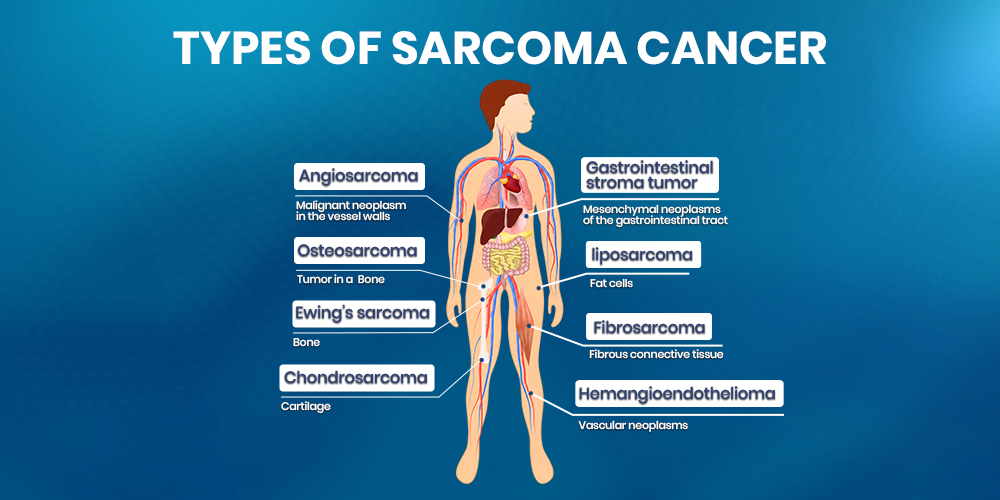
There are over 70 recognized subtypes of sarcoma cancer. They fall into two broad categories: soft tissue sarcomas and bone sarcomas.
Soft Tissue Sarcomas
These are the more common groups. They develop in fat, muscle, nerves, fibrous tissue, or blood and lymph vessels.
Key types of this cancer in the soft tissue category include:
- Liposarcoma — originates in fat cells; the most common soft tissue sarcoma in adults
- Leiomyosarcoma — arises from smooth muscle; frequently found in the uterus or stomach
- Undifferentiated Pleomorphic Sarcoma (UPS) — previously called malignant fibrous histiocytoma; tends to be aggressive
- Synovial Sarcoma — despite its name, it doesn’t arise from synovial tissue; it is common in adolescents and young adults near joints.
- Rhabdomyosarcoma — develops in skeletal muscle cells; it mostly affects children.
- Angiosarcoma — grows in blood or lymph vessel walls; can appear in the scalp, breast, or liver.
- Kaposi Sarcoma — a cancer linked to abnormal blood vessel growth, often associated with weakened immune systems or viral infections such as HHV-8. It commonly affects the skin but can also involve internal organs.
- Gastrointestinal Stromal Tumor (GIST) — occurs in the digestive tract; responds well to targeted therapy.
Bone Sarcomas
Less common than soft-tissue sarcomas but particularly prevalent in children and teenagers.
Key types of this cancer affecting the bone include:
- Osteosarcoma — the most common bone cancer; it frequently affects the knee, upper arm, or thigh in adolescents
- Ewing Sarcoma — aggressive and fast-growing; often found in the pelvis, ribs, or long bones of the legs.
- Chondrosarcoma — develops in cartilage; more common in adults over 40
Each subtype behaves differently. An osteosarcoma in a 14-year-old responds to chemotherapy in ways that a chondrosarcoma in a 55-year-old might not. The subtype determines the entire treatment strategy.
Sarcoma Cancer Symptoms
Early detection is challenging because sarcoma cancer symptoms often mimic benign conditions.
A small lump may not cause pain at first. That is where the delay happens.
Common signs include:
- A growing lump under the skin
- Persistent swelling in limbs or trunk
- Mild to moderate pain as the tumor grows
- Limited movement near joints
- Unexplained fractures in bone sarcoma cases
Sarcoma cancer symptoms vary depending on location. For example, abdominal sarcomas may cause digestive discomfort, while limb tumors affect mobility. Clinicians often stress that the symptoms lasting more than a few weeks should be evaluated. Repeated assessment of the symptoms helps rule out benign cysts or muscle injuries.
In many cases, patients ignore the cancer symptoms until pain becomes consistent or a visible mass increase.
When to See a Doctor?
The general guidance is this: any new soft tissue lump that is growing, deeper than the skin surface, or larger than 5 cm should be evaluated by a doctor promptly. Don’t wait to see if it “goes away.”
Early detection dramatically changes outcomes. A localized sarcoma has an 82.6% five-year survival rate. That number doesn’t hold once the cancer spreads.
Stages of Sarcoma Cancer
Staging describes how far cancer has spread. It directly affects the treatment strategy.
Early stages are localized. Later stages indicate spreading.
Localized disease
A tumor remains in one area. Surgery is often the primary treatment.
Regional spread
Cancer begins to affect nearby tissues or lymph nodes.
Advanced disease
At this point, treatment becomes more complex. Stage 4 sarcoma cancer means the disease has spread to distant organs such as the lungs or liver.
Stage 4 cancer is considered metastatic. However, outcomes still vary depending on tumor type and response to therapy. Some patients with stage 4 cancer respond well to chemotherapy or targeted therapies, especially in specific subtypes.
Doctors often reassess stage 4 cancer continuously because progression patterns differ widely. Even within this stage, survival can vary significantly based on genetic markers.
Where Are Most Sarcomas Found?
Sarcomas can develop almost anywhere in the body because they arise in connective tissues such as muscles, fat, nerves, and bones. However, some areas are affected more often than others:
- Around 40% of sarcomas develop in the lower extremities, including the legs, ankles, and feet.
- About 15% occur in the upper extremities, such as the shoulders, arms, wrists, and hands.
- Nearly 30% are found in the trunk region, including the chest wall, abdomen, and pelvis.
- The remaining 15% occur in the head and neck area.
How is Sarcoma Cancer Diagnosed?
Diagnosis involves several steps, and getting it right matters enormously.
A radiologist and pathologist experienced in sarcoma can mean the difference between a correct diagnosis and a misread biopsy. Studies show that sarcoma misdiagnosis rates remain high at non-specialist centers.
Typical diagnostic workup:
- Imaging — MRI is the preferred method for soft tissue tumors; CT scan is used for bone involvement and to check for lung metastases (where sarcoma most commonly spreads)
- Biopsy — a core needle biopsy or surgical biopsy is needed to confirm the diagnosis and identify the subtype; this must be done by or in consultation with a sarcoma specialist, because a poorly placed biopsy can complicate surgery later.
- Molecular testing — some sarcomas carry specific gene fusions (like SS18-SSX in synovial sarcoma or EWSR1 in Ewing sarcoma) that help confirm diagnosis and guide targeted therapy.
Staging follows diagnosis. Sarcomas are staged from I to IV based on tumor size, grade (how abnormal the cells look), and whether the cancer has spread to lymph nodes or distant organs.
Stage 4 Sarcoma Cancer
Stage 4 cancer means the disease has spread beyond its original location, typically to the lungs, but also potentially to the liver, bones, or brain.
It’s the most difficult stage to treat. But it’s not uniformly fatal.
What Makes Stage 4 Different?
At this stage, the cancer is no longer a local problem. Surgery on the primary tumor alone won’t cure the disease. Treatment has to address both the primary site and the metastatic sites simultaneously.
Treatment Options for Stage 4 Sarcoma Cancer
- Chemotherapy — the primary treatment for most metastatic sarcomas; regimens typically include doxorubicin, ifosfamide, or gemcitabine-docetaxel, depending on subtype
- Targeted therapy — GISTs respond remarkably well to imatinib (Gleevec), a targeted drug; some other subtypes also have targetable mutations
- Immunotherapy — still being studied; responses vary significantly by subtype
- Metastasectomy — surgical removal of lung metastases; this is sometimes curative when the spread is limited to the lungs, and all lesions can be removed
- Clinical trials — often the best option for stage 4 patients; new agents and combinations are actively being studied. Enrolling in clinical trials for oncology helps open new gates of advancement and better treatment approaches.
Conclusion
To conclude, sarcoma cancer is complex and unpredictable. It demands early attention, accurate diagnosis, and specialized care. Recognizing sarcoma cancer symptoms can change outcomes. Understanding types of sarcoma cancer helps patients and families make informed decisions.
Additionally, NHO Revive is conducting clinical research studies in Nebraska to help find better cure options. We tend to advance clinical therapeutic options for patients living with sarcoma, and for this, we need your participation. Enroll with us today in solid tumor clinical trials and help reshape what a better treatment option could look like.
Frequently Asked Questions
What is the sarcoma cancer survival rate?
The sarcoma cancer survival rate depends on the type, stage, tumor size, and how early it is diagnosed. Localized sarcomas that have not spread generally have a much higher survival rate than advanced or metastatic cases. Early diagnosis and timely treatment often improve outcomes significantly.
What are the first signs of sarcoma?
The first signs of a sarcoma often include a painless lump or swelling that gradually increases in size. Some people may also experience persistent pain, tenderness, or reduced movement near the affected area. Bone sarcomas can sometimes cause unexplained fractures or deep aching pain.
Is sarcoma a fast-spreading cancer?
Some sarcomas grow slowly, while others can spread aggressively. The speed of progression depends on the specific subtype and stage of the disease. High-grade sarcomas are more likely to spread quickly, especially to the lungs or nearby tissues, which is why early evaluation is important.